By Michele (Shelley) Trucksis

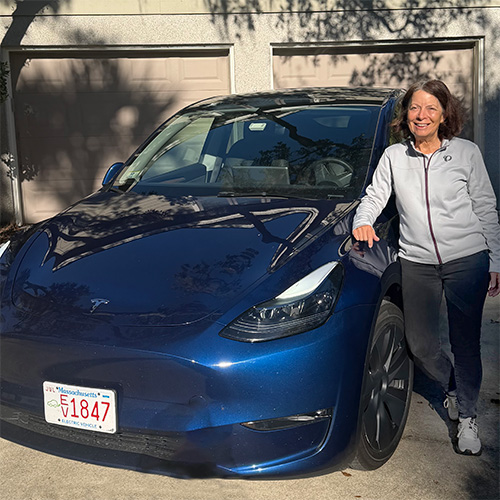
When people learn that I drive an electric vehicle, one of the first questions they ask is, “But what about long trips?” Closely followed by, “Don’t you worry about running out of charge?”
I used to wonder the same thing. In fact, early on, I had a moment that taught me more about EV driving than any manual could.
On one of my first long trips in my Tesla we were driving from Wayland to Charleston, S.C. The car’s screen clearly notes that range estimates become less accurate when driving over 70 mph. I mentioned this to my co-driver as we cruised along at about 80 mph and suggested slowing down so we wouldn’t risk running low. He didn’t. As the miles rolled by, the projected range dropped faster than expected, until — uncomfortably — we hit zero miles remaining.
What happened next surprised me. The car didn’t stop. We were able to locate a charger within about five miles, and Tesla had quietly built in a small reserve for exactly this situation. We arrived, plugged in, and then continued.
Lesson learned: the system is smart, but physics still applies. My advice to new EV owners is simple: heed the warning and don’t drive over 70 if you want to maximize range and minimize stress.
Since then, range anxiety has largely disappeared for me, especially on road trips. A big reason is charging infrastructure. Tesla’s Supercharger network is extensive and dependable, not just along major highways but also in smaller towns and more rural areas.
When I enter a destination, the car plans the route, schedules charging stops, and adjusts in real time for traffic, weather, and elevation. Most of the mental load is managed for you.
I recognize that this perspective comes from being a Tesla owner, but the EV landscape is evolving rapidly. Tesla has opened its Supercharger network to many other automakers, and most major manufacturers —including Ford, GM, Hyundai, Kia, Rivian, Volvo, BMW, and others — now offer their EV drivers access as well. Some vehicles require an adapter and an app, while newer models have Tesla’s charging port built in. In practical terms, this means long-distance EV travel is becoming easier and less brand-dependent.
Another shift for new EV drivers is how to think about range. On road trips, I focus less on total miles and more on how much charge I will have when I arrive at the next stop. Arriving with 10 to 20 percent battery is normal. Charging stops usually align with things I’d do anyway — bathroom breaks and meals — and shorter, faster charges are often more efficient than waiting for a full battery.
My biggest advice for new EV owners is to plan ahead, trust the technology, and give yourself a little margin. After a few trips, confidence replaces concern. In my experience, the reality of EV road-tripping is far less stressful — and far more convenient — than the myths suggest.